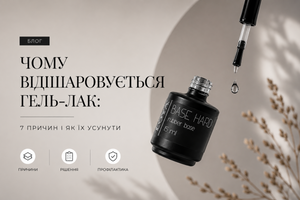
In summer, gel polish lasts less for almost everyone — and it's not about clumsy hands, it's about the season. Let's break down why this happens and how to adjust your work so your coating holds its full four weeks again.
Sound familiar? A client whose winter manicure stayed put for all four weeks shows up in July on day ten — with lifting near the cuticle and one corner already living its own life. You didn't change your hands, the material is the same, your routine is the same. Yet the wear time went out for a walk.
It's not you, and often not even the material — it's fine. Summer just has its quirks, and the season itself is playing against us.
Why Gel Polish Holds Worse in Summer
Summer is a natural sauna for nails, and moisture plus heat are adhesion's main enemies.
The nail plate isn't as solid as it looks. It's porous keratin that reacts to its environment and soaks up moisture beautifully. When it's hot and humid, the plate absorbs water like a sponge and expands, then returns to its natural shape as it dries. On top of that, the nail's natural oiliness increases. All of this kicks into high gear.
Add the client's habits. In the heat she washes her hands more often, spends longer in water — showers, the sea, the pool, dishes at the cottage. Hand sanitizer ten times a day doesn't rest either. Skin and nails swell with moisture, then dry out again — round and round, every day.
For the coating, that's constant movement. The gel is dense and stable, while the plate beneath it keeps taking on water and releasing it. At the "natural nail — base" boundary, microtension appears. At first it's invisible, then it gives that familiar picture: lifting from the cuticle side or a popped corner.
So what do you do? At what stage can it be fixed? And is it even possible? Yes, it is — because summer is the season when the small things in prep start deciding everything.
What Happens to Adhesion in Summer
Adhesion is the bond between the base and the nail. For it to be strong, the plate needs to be dry, degreased, and slightly rough. Any moist or oily film between the nail and the base works like an invisible plug: the base seems to have set, but it's actually holding onto a thin layer of water and oil, not the nail.
In summer there's objectively more of that film. Increased sweating and active oil glands mean that even a properly degreased nail can recoat itself with a microfilm within a minute or two — while you're distracted by your phone or a chat.
The second part of the story is the base. Acid-free bases simply can't cope with the plate constantly absorbing water, because they're designed to bond as gently as possible. In summer I always recommend switching to medium-acid or acid bases — they're what guarantees adhesion in extreme conditions. Remember: a base is chosen not only by nail type but by need. When nails are damp or constantly in water, acid bases are the better call.
How to Avoid Lifting in Summer: A Master's Protocol
A few working steps that genuinely save wear time in the heat:
Degrease in two or three passes, not one. In summer, a single swipe of cleanser isn't enough. Go over the plate, wait a second, go over it again — especially the cuticle zone, where lifting starts most often. A fresh lint-free wipe every time.
Don't touch the nail with your fingers after degreasing. Obvious, but in summer it costs the most. Next — primer. I know plenty of people have dropped it, but in summer it's a must-have. Feel free to use acid primer: it works in the deeper layers of the nail, degreasing them. Scared of acid? Use at least an acid-free one, but remember: primer in summer is MANDATORY.
Prepped — straight to the base, no scratching your nose. First layer thin, with rubbing motions. Cure a full minute, no interruptions.
Match the base to the nail, not one for everyone. Thin, flexible nails want a denser base that gives support. And vice versa.
Talk the first 24 hours through with your client. A hot bath, sauna, or long dishwashing right after the service steams the plate — and even flawless work can lift. It's not magic, it's physics, and your client should know about it.
By the way, it's no coincidence that hot countries see the most lifting cases — masters there have long worked mostly on acid bases, because otherwise the coating simply doesn't hold.
Which Base to Choose for Summer — And How LOYA Helps
Half the summer problem is a base that doesn't bond to the nail reliably.
LOYA Hard and Base Strong are medium-acid bases: they apply in a thin, even layer and bond firmly to the plate. Strong is softer and runnier — great as a foundation under gel systems and on normal, healthy nails. Hard works both as a standalone base and as a base under gel systems; it's thicker than Strong and has already been tested by hot countries, where it's loved for its reliable grip. The whole line is TPO-free and 7-free — a cleaner formula with no loss of strength.
For summer I'd also point you to LOYA Super Top: it protects color from fading and holds shine right up to the refill.
Takeaway
Gel polish lasts less in summer not because you suddenly forgot how to work, but because heat and moisture turn nails into a little sauna. Adhesion suffers from moisture and oil, and the coating suffers from busier hands. The master who wins is the one who tunes the protocol to the season: double degreasing, mandatory primer, medium-acid bases, and understanding what's happening and why.
So how's your summer holding up — what goes first, the cuticle or the free edge? Tell me in the comments, let's figure it out together.
FAQ
Why does gel polish last less in summer?
Heat and moisture make the nail plate absorb water, expand, and release more oil. This ruins base adhesion, so the coating lifts more often than in winter.
Which primer should I use in summer?
In summer, primer is mandatory. Acid primer works more reliably because it degreases the deeper layers of the plate. If nails are healthy and you'd rather skip acid, use an acid-free one — but don't go without primer at all in the heat.
Acid or acid-free base in summer?
In the heat, acid-free bases hold worse because acid is what's responsible for adhesion. The best option is a medium-acid base: reliable grip without over-drying the plate.
Why does gel polish lift right at the cuticle?
It's the zone with the most moisture and movement. If it's under-degreased there, or you touched the plate with a finger before the base, lifting will start there first.